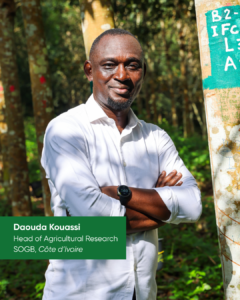
At Socfin, agronomic progress is built on the people who dedicate their careers to understanding the land. Daouda Kouassi, Head of the Agricultural Experimentation Department at SOGB, our rubber plantation subsidiary in Côte d’Ivoire, recently completed his doctoral thesis in genomic selection for rubber trees, a research project carried out with the full support of SOGB, including access to experimental plots, field data, and dedicated time to balance research with his professional responsibilities. We sat down with him to learn more about his journey, his research, and what it means for the future of rubber cultivation.
What drew you to agriculture and agricultural research, and what led you to pursue your doctoral thesis at Université Jean Lorougnon Guédé?
My training is in agronomic sciences and plant genetics. I completed a Master’s degree in Natural Sciences at the University of Abobo-Adjamé, now known as Université Nangui Abrogoua, followed by a postgraduate diploma in Genetics with a specialization in plant species improvement at Université Félix Houphouët-Boigny in Abidjan. Before joining SOGB in 2015, I worked as a Junior Scientist at the World Agroforestry Centre in Côte d’Ivoire, where I focused on cocoa research and development.
Agriculture is a very concrete field. You can see the direct impact of your work. I am naturally curious and practical, and I enjoy finding solutions to real problems. Agricultural research fits that mindset well: you test, measure, analyse, and then propose improvements based on objective data. The thesis followed naturally from that approach. It allowed me to deepen my knowledge, build a stronger scientific foundation, and master advanced tools in genetics and data analysis, with the goal of contributing meaningfully to genetic progress in rubber cultivation.
Can you explain your research in simple terms, and why it matters for rubber cultivation?
My thesis focused on genomic selection. In simple terms, this means using the information contained in a tree’s DNA to predict how well it will perform in the future, whether in terms of production potential or disease resistance.
Rubber trees take several years before you can fully measure their results. This approach allows us to make decisions earlier and move faster. It can save significant time in identifying the best performing clones and progressively improve plantation productivity.
What are the concrete impacts of this work, and what are your next steps?
The main impact is improving the productivity of rubber plantations. By making the most of genetic and agronomic data, we can identify high-performing clones earlier, ones that are also well-adapted to local conditions. Over time, this means plantations that are more productive, more resilient, and better prepared for future challenges, whether those are climate-related or linked to plant health.
Looking ahead, I want to keep building my skills in data analysis and emerging tools like machine learning and artificial intelligence, to support more precise and well-informed decisions. I am convinced that the future of rubber cultivation lies in better integration between research, field data, and strategic decision-making. That is the direction I want to help move us toward.
Daouda Kouassi’s journey reflects a broader commitment within the Socfin Group: investing in people, building expertise from within, and connecting scientific research to the day-to-day realities of responsible tropical agriculture. At Socfin, progress in the field starts with the people who understand it best.